
As the year concludes, Joey Bose reflects on gratitude towards investors, the Cytonics community, and the dedicated team. He emphasizes the importance of long-term commitment and support in their progress. Looking ahead to 2026, he encourages everyone to cherish time with loved ones and appreciate their contributions.
Joey Bose, our CEO and President, breaks down why researchers have called A2M the 'physiological guardian.' A2M, or alpha-2-macroglobulin, is a natural protein found in your bloodstream that acts like a bodyguard against inflammation and joint destruction. It works as a broad-spectrum protease inhibitor and also sequesters cytokines – the same inflammatory signals you heard…
How Cytonics is preparing for its next regulatory milestone — from database lock to FDA engagement.
It’s been just over a month since we wrapped up our $7M crowdfunding campaign — our largest and most successful raise to date — and the pace hasn’t slowed for a moment. Since then, our team has been hard…

The message emphasizes gratitude towards patients and investors who contribute to Cytonics’ mission. Highlighting milestones like treating over 10,000 patients and issuing 25 patents, it reinforces that Cytonics is community-driven and not just a typical biotech firm. The team appreciates all stakeholders and encourages further investment.

Cytonics aims to address osteoarthritis, impacting over 500 million globally, with its innovative CYT-108 therapy. Positioned strategically in capital markets, the company targets Phase 2-ready investments. With strong intellectual property and funding strategies, Cytonics is well-prepared for M&A opportunities, benefiting from current biotech trends and investor interests.
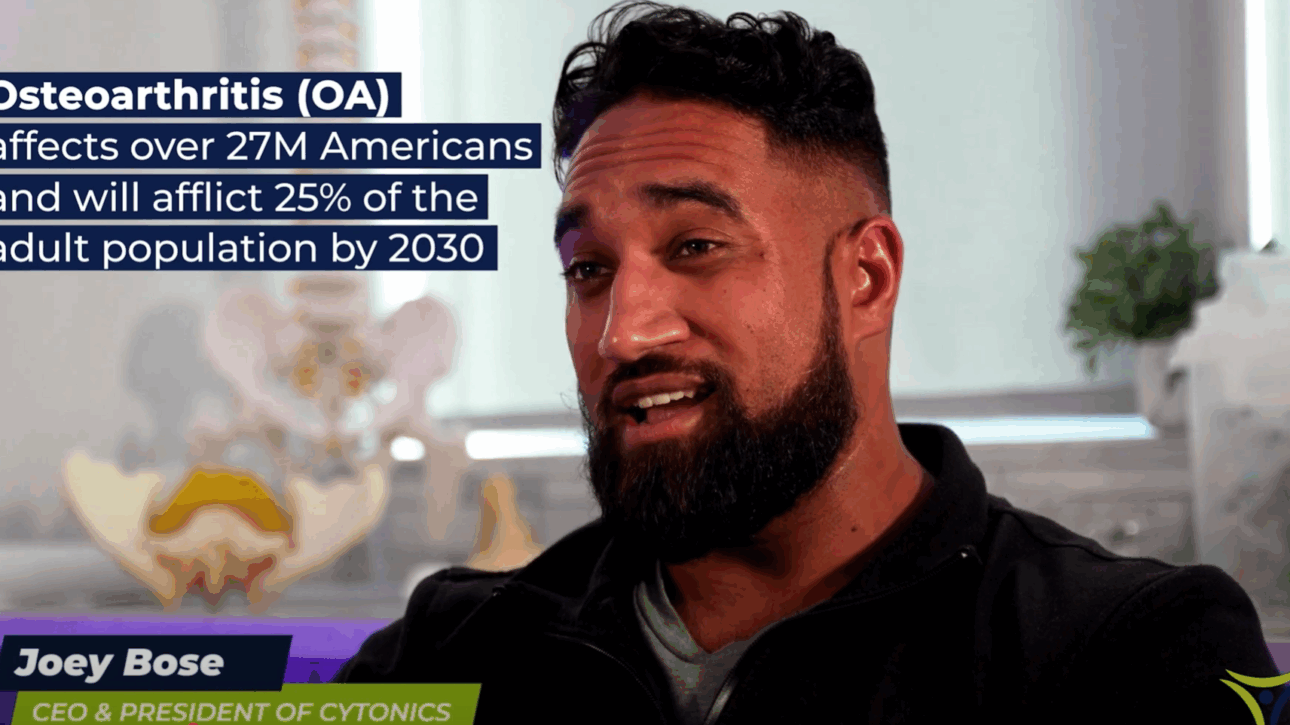
Cytonics has released a video featuring CEO Joey Bose, explaining how their therapy CYT-108 challenges Big Pharma by targeting osteoarthritis’s root causes, rather than just symptoms. The video discusses past successes with APIC, the science behind their approach, and future strategies. Viewers are encouraged to support the company as potential shareholders.

Cytonics CEO Joey Bose discussed their groundbreaking approach to osteoarthritis with investor Kevin O’Leary. The biotech firm has treated over 10,000 patients and developed a therapy, CYT-108, which has completed Phase 1 trials. With $15M raised from 6,000 everyday investors, Cytonics challenges traditional Big Pharma funding models.

Cytonics has completed its first-in-human trial for CYT-108, a recombinant protease inhibitor for knee osteoarthritis. The 22-patient Phase 1 study focused on safety and efficacy, providing data for an FDA IND application and Phase 2 protocol. This milestone boosts prospects for a disease-modifying therapy and enhances shareholder value.

Cytonics is seeking $24 million to fund a Phase 2 Clinical Study for CYT-108, its innovative osteoarthritis therapy. This fundraising effort, in partnership with StartEngine, utilizes Regulation A+, allowing unaccredited investors to participate. CYT-108 offers unique protease inhibition benefits and builds on the success of its predecessor, the APIC system.
Cytonics Corporation has received US Patent No. US 12,195,521 B2 for its engineered A2M variant, CYT-108. This patent enhances its competitive position by expanding therapeutic applications and securing exclusivity for two decades. It strengthens barriers to entry, increases licensing opportunities, and supports funding initiatives for future product development.

The first nine patients have completed the Phase 1 clinical trial of CYT-108, with no reported adverse events. This biologic therapy aims to treat osteoarthritis by targeting cartilage-degrading enzymes. The company plans to initiate Phase 2 trials and will launch an equity crowdfunding campaign to finance further development.

As 2024 ends, Cytonics reflects on remarkable progress in developing their drug CYT-108 for osteoarthritis treatment. The first clinical trial began, greatly aided by a team of orthopedic specialists. Plans for Phase 2 trials are underway, with fundraising efforts expected in early 2025 to support research and development.